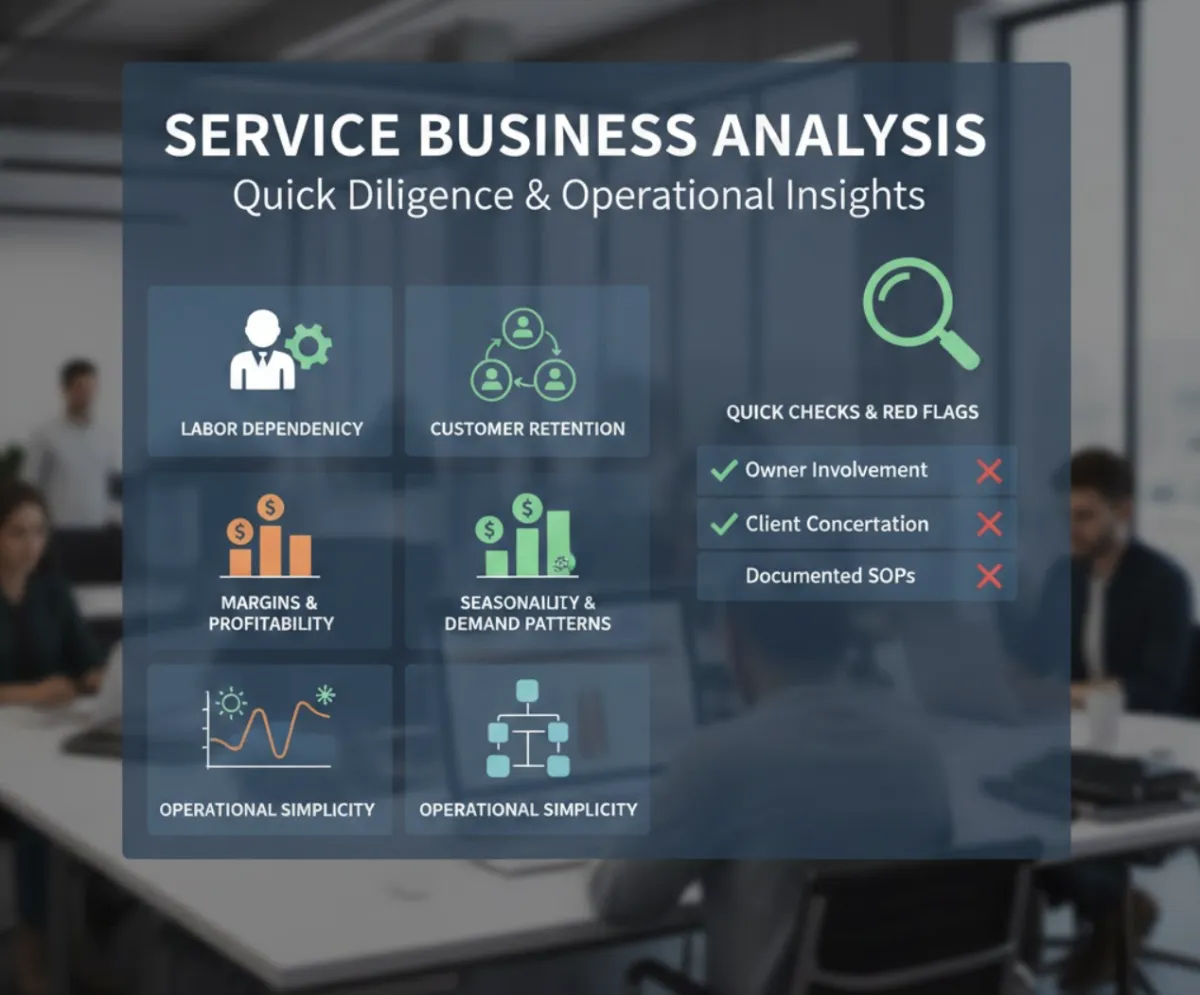
How to Analyze a Service Business Quickly
Buying a service business can be a powerful way to enter entrepreneurship, but analyzing it efficiently is key. Many prospective buyers get bogged down in endless spreadsheets and meetings, missing critical signs of operational risk or opportunity. Understanding how to perform a rapid yet thorough analysis can save time, reduce risk, and improve decision-making.
The Quick Service Business Analysis Framework
To evaluate a service business quickly, focus on five key areas that reveal operational health and scalability.
1. Labor Dependency
Assess how reliant the business is on the owner versus staff.
High owner dependency signals higher transition risk.
Check if employees have training, standard procedures, and autonomy.
2. Customer Retention & Concentration
Examine customer lists for repeat business and longevity.
Identify dependency on a few clients; heavy reliance increases risk.
Use metrics like churn rate and lifetime value where available.
3. Margins & Profitability
Look at gross margins and net profits.
Compare against industry norms.
Review recurring expenses and seasonal fluctuations.
4. Seasonality & Demand Patterns
Analyze monthly revenue trends.
Seasonal businesses require strong cash management.
Ensure demand aligns with buyer capability to manage fluctuations.
5. Operational Simplicity
Evaluate how standardized processes are.
Simple, repeatable operations are easier to transition and scale.
Identify any hidden complexities or dependencies on specialized skills.
Quick Checks & Red Flags
Metric Quick Check Red Flag Owner Involvement Observe day-to-day tasks Owner performs all work Customer Concentration % of revenue from top 5 clients >50% revenue from few clients Margins Compare gross/net margins to benchmarks Margins declining or volatile Staff Capability Review team structure & roles No cross-trained staff Processes Presence of documented SOPs No standardization
Real-World Example
A buyer reviewed a small IT services firm with high repeat customers but discovered that the owner personally handled all client onboarding. Despite strong revenue, the transition risk was high. By identifying this early, the buyer either renegotiated terms or planned for intensive transition support.
Best Practices for Rapid Analysis
Use a structured checklist like YourNextVenture.ai’s Quick Diligence Checklist to stay focused.
Conduct brief site visits to validate operations and staff capability.
Speak directly with key employees and top clients to confirm retention and satisfaction.
Compare financials against industry standards for sanity checks.
FAQ
Q: What is service business analysis and why is it important?
A: It's the process of evaluating operational, financial, and customer factors quickly to identify risks and opportunities before acquisition.
Q: How long should a quick diligence take?
A: Typically 2-5 days for preliminary analysis, longer for deep dives.
Q: Which red flags should I watch for most closely?
A: High owner dependency, client concentration, messy financials, and lack of documented processes.
Q: Can I rely solely on financial statements?
A: No, combine financial review with operational and client insights for a complete picture.
Q: Are there tools to streamline this analysis?
A: Yes, YourNextVenture.ai provides checklists, guides, and frameworks to help buyers evaluate businesses efficiently.
Conclusion
Ready to analyze service businesses confidently and reduce acquisition risk? Explore YourNextVenture.ai’s tools and checklists to perform quick diligence and make smarter buying decisions.


